Can You Trust AI Answers? Ask a Second AI From Another Company

You are about to act on something an AI told you: sign a contract, pay a sum, meet a deadline, send a letter you cannot take back. A quick way to find the line worth checking is to ask an AI made by a different company and see where the two answers part ways. Duocall does that for you.
Duocall is a free, open-source plugin for Claude Code, Anthropic's AI assistant that works with files on your own computer. It puts your question, unchanged, to an AI from another company: a program already installed and signed in on your computer if there is one, or else a free chat in your browser, with the exact text to paste. Then it shows where the two agree, quoting both, and names every place they differ: every number, date, name and next step. It needs no API key (the paid access code some AI services sell to programmers), no new account and no second subscription.
Why a second AI, and why another company
People already bring AI the questions that matter. In a KFF poll published in March 2026, about a third of U.S. adults (32%) said they had turned to AI for health information and advice. And people type their doubts into Google: "can you trust ai answers", "is chatgpt reliable for legal advice". One AI cannot settle that about itself, because a confidently wrong answer reads exactly like a confidently right one.
A second AI from the same company does not help much: two answers from one maker are one opinion wearing two hats. A study of more than 350 language models found that shared architectures and providers make errors line up, and that on one test set, when two models were both wrong, they agreed 60% of the time (Kim et al., ICML 2025). So Duocall only pairs Claude with another company: OpenAI through Codex, Google through Antigravity or the Gemini CLI, xAI through Grok, Moonshot through Kimi, or Alibaba through Qwen. Even then it never treats agreement as proof. In its own words: "Agreement means no obvious error is visible - and the differences show exactly where to look."
What it does, in four commands
/duocall:askputs your question to an AI from another company and brings the answer back whole, marked as theirs. Before asking, it tells you who it will ask./duocall:comparelays the two answers side by side. Every line under "Agreed" carries a quote from each answer; a point that cannot be quoted from both goes on the other list. "Disagreed" names every difference, however small./duocall:deepengoes back about the disputed point only. One narrow question goes to both AIs, naming the disagreement but never who said what. If they still disagree, Duocall gives you the one step that settles it: the line of the document to read, or the person to call with one exact question./duocall:whocloses with four lines, always the same: who answered, who did not, who was never asked, and the total, counted in companies, not in answers.
You do not have to remember the commands. "Ask another AI" or "get a second opinion" is enough. When the stakes are real (money, health, a contract, a deadline), Claude offers a second opinion itself, once, and it runs on your word.
A concrete example
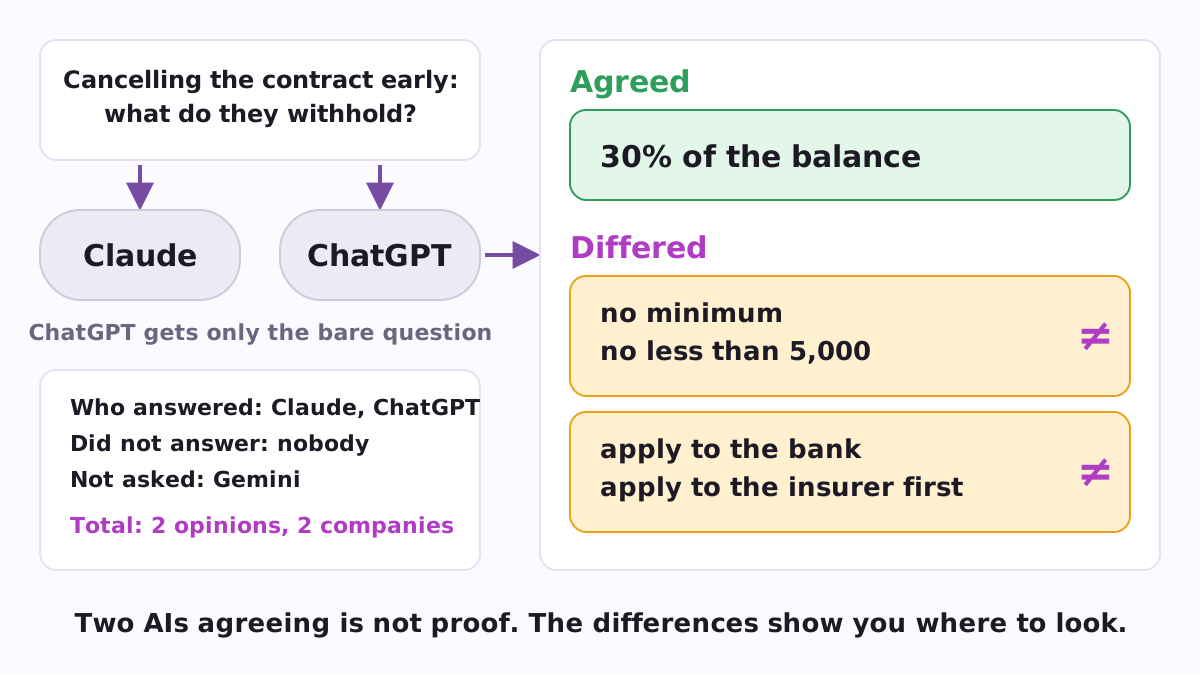
You ask what is withheld if you cancel a contract early. One AI says 30% of the balance and tells you to apply to the bank. The other says 30% of the balance but no less than 5,000, and tells you to apply to the insurer first. At a glance the answers look the same. Duocall puts "30% of the balance" under Agreed with both quotes, and names the two differences: the minimum, which makes the second answer higher on a small balance, and who to apply to. Those are the two lines to check in your contract. Then it ends with the four lines:
Who answered: me (Claude) and ChatGPT.
Did not answer: nobody.
Not asked: Gemini — it's not on this computer.
Total: two opinions, from two different companies.
The question goes over bare
An AI shown somebody else's answer tends to agree with it. In one study, a user merely suggesting a wrong answer cut a model's accuracy by up to 27% (Sharma et al.), and in April 2025 OpenAI rolled back a ChatGPT update that had become "overly validating and agreeable" (TechCrunch). So Duocall sends your question exactly as you asked it: no summary, no Claude answer attached, no hint that the other AI is "checking". Say "ask a second AI: am I entitled to a tax deduction for dental treatment?", and only the question after the colon goes over.
When both AIs wrote something you will send under your own name, such as a letter to a neighbour, Duocall does not blend the two into a third text. You get one of them whole, and beside it a list of what the other does better.
No second program? The browser does the job
If there is no second AI program on the computer, Duocall hands you a short block with your question and nothing else. Open any free chat from another company in your browser, such as ChatGPT, Gemini or Grok, paste it in, and bring the reply back. Duocall compares it exactly as it would a program's answer. If a program's monthly allowance runs out, Duocall says so plainly, says it comes back on its own, and offers the browser path in the meantime.
How it was checked
Duocall's rules are tested on what a model actually says, not on whether a sentence appears in its instructions. Nine scenarios hand a model the skill and a situation (an allowance that ran out, a request to blend two letters, an agreement only one answer supports), and fixed text patterns check the reply, with no AI judging another AI. On 10 October 2026, the replies recorded from seven models passed all nine scenarios for six of them, and eight of nine for Claude Haiku. The plugin also has 43 automated tests, and its Python launcher has been checked on Windows, Mac and Linux.
Sidecall, Roundcall or Duocall?
Duocall has two siblings built on the same idea.
- Duocall (this page) asks one AI from one other company, for a person's decision, in plain words, and works through the browser when no second program is installed.
- Sidecall asks up to four AI command-line programs at once and writes one claim-by-claim report; it also sends code or a plan to a critic from another company. It suits people who already use AI tools in a terminal.
- Roundcall asks AI chat websites by opening tabs in your own Chrome.
How to start
You need Claude Code 2.1.224 or later (claude update brings it up to date) and Python 3. In Claude Code, type:
/plugin marketplace add https://raw.githubusercontent.com/vadimchernets/poly-a1-plugins/main/.claude-plugin/marketplace.json
/plugin install duocall@poly-a1
The first line adds the Poly A1 plugins catalogue by its link, with no git and no GitHub account needed. Then open /plugin, go to Marketplaces and turn on auto-update for poly-a1, so later improvements reach you by themselves. Duocall answers in your language; its fixed sentences come ready-made in English, Spanish, Portuguese, Russian and Ukrainian.
Duocall is one of the Poly A1 plugins by Vadym Chernets. Its central rule, that a second opinion must come from a different company, is set out in the paper Agreement Is Not Independent Evidence (SSRN 7390698): "a pair drawn from two laboratories can outweigh five drawn from one". The code uses only Python's standard library, is released under the Apache-2.0 licence and archived on Zenodo (DOI 10.5281/zenodo.23107731). Everything is at github.com/vadimchernets/duocall.
Vadym Chernets also builds Poly A1, an app in which AIs from different companies check each other's work.